
Profiting When Others Panic
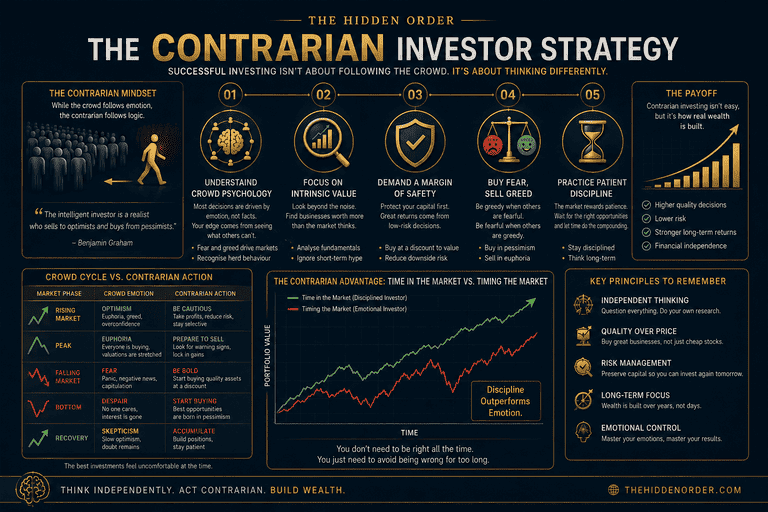
At The Hidden Order, we believe that the market’s greatest opportunities are hidden in plain sight, concealed beneath the noise of crowd behavior. The contrarian investor strategy is built on a deceptively simple premise: the majority of investors are often wrong at critical turning points. When fear grips the market and prices collapse, the herd sells indiscriminately. When euphoria reigns and valuations soar beyond reason, the crowd buys with abandon. The contrarian does the opposite. This approach requires discipline, patience, and the emotional fortitude to stand apart from the consensus.
The intellectual foundation of contrarian investing traces back to legendary figures such as Benjamin Graham, the father of value investing, and his most famous student, Warren Buffett, who immortalized the philosophy with the phrase: “Be fearful when others are greedy, and greedy when others are fearful.” Sir John Templeton built one of the greatest investment records of the twentieth century by buying “at the point of maximum pessimism.” Contrarian investing is not about being different for the sake of it: it is about recognizing that markets are driven by human emotion, and emotion creates mispricing that a rational investor can exploit.
Why the Crowd Is Often Wrong
Markets are not perfectly efficient machines; they are collections of human beings subject to psychological biases. Understanding these biases is the first step toward exploiting them. When investors move together in a herd, they amplify price movements far beyond what fundamentals justify. This creates the pricing dislocations that contrarians seek.
- Herd mentality: Investors feel safer following the crowd, leading to bubbles at the top and panic-driven crashes at the bottom.
- Recency bias: People assume recent trends will continue indefinitely, chasing winners at their peaks and abandoning losers at their troughs.
- Loss aversion: The pain of a loss feels roughly twice as powerful as the pleasure of an equivalent gain, prompting irrational selling during downturns.
- Confirmation bias: Investors seek information that supports their existing beliefs while ignoring contradictory evidence.
- Overreaction: Markets frequently punish bad news too severely and reward good news too generously, creating gaps between price and intrinsic value.
The contrarian recognizes that these behaviors are systematic and predictable. By maintaining emotional distance and relying on data rather than sentiment, the disciplined investor positions themselves to buy quality assets at a discount and sell overpriced ones before the correction arrives.
The Core Principles of Contrarian Investing
Successful contrarian investing is not simply about buying what is falling. A declining stock may be cheap for good reason. The art lies in distinguishing between temporary mispricing driven by sentiment and genuine deterioration in a company’s prospects. The following principles form the backbone of a sound contrarian framework.
- Focus on intrinsic value: Determine what a business is genuinely worth based on its earnings power, assets, and future cash flows, not on where its stock price happens to be trading today.
- Demand a margin of safety: Buy only when the market price sits meaningfully below your estimate of intrinsic value, providing a cushion against errors in judgment.
- Seek quality at a discount: The best contrarian opportunities involve fundamentally strong companies that have been temporarily beaten down by market pessimism.
- Embrace unpopular sectors: Look toward industries and stocks that the market has abandoned, where negative sentiment has created bargains.
- Think long term: Contrarian positions may take months or years to be validated by the market. Patience is not optional: it is essential.
Identifying Contrarian Opportunities
Finding genuine contrarian opportunities requires a combination of quantitative screening and qualitative judgment. The goal is to locate assets that the market has mispriced due to emotion rather than fundamentals. Begin by screening for companies trading at low price-to-earnings and price-to-book ratios relative to their historical averages and their industry peers. These metrics often signal that a stock has fallen out of favor.
Next, examine sentiment indicators. Extreme readings on fear-and-greed indices, unusually high short interest, or a wave of analyst downgrades can all point toward maximum pessimism, precisely the conditions in which contrarian value emerges. Insider buying is another powerful signal; when executives purchase shares of their own company during a downturn, they are betting real money on a recovery that the broader market cannot yet see.
Crucially, the contrarian must then verify that the underlying business remains sound. Ask whether the company maintains a durable competitive advantage, a healthy balance sheet, and the ability to generate cash even in difficult conditions. If the answer is yes, and the market has punished the stock out of proportion to any real threat, you may have found a genuine opportunity.
Managing Risk as a Contrarian
Going against the crowd is inherently risky, because sometimes the crowd is right. Effective risk management separates the successful contrarian from the reckless gambler. The following practices help protect capital while pursuing outsized returns.
- Diversify across positions: Never concentrate your entire portfolio in a single contrarian bet, no matter how compelling the thesis appears.
- Scale in gradually: Build positions in increments rather than committing all your capital at once, allowing you to average into further declines.
- Set clear exit criteria: Define in advance the conditions under which you would sell, whether the thesis is proven or disproven.
- Distinguish value traps: Avoid businesses in structural decline, where a low price reflects a permanently impaired future rather than a temporary setback.
- Maintain a cash reserve: Keeping dry powder allows you to seize opportunities when others are forced to sell.
The Psychological Discipline Required
Perhaps the greatest challenge of contrarian investing is not analytical but psychological. Buying when headlines scream doom and selling when optimism peaks feels profoundly unnatural. The contrarian must be prepared to look wrong for extended periods, to endure the discomfort of standing alone, and to resist the constant temptation to rejoin the herd. This is why so few investors succeed at it, and why those who master it are so richly rewarded.
Developing this discipline requires a written investment plan, a commitment to process over outcome, and a willingness to trust rigorous analysis over the emotional pull of the crowd. The contrarian treats market panics not as threats but as sales, and treats bubbles not as opportunities to be missed but as warnings to be heeded.
Building Your Contrarian Edge
The contrarian investor strategy is not a shortcut to easy riches: it is a demanding discipline that rewards patience, independent thinking, and emotional control. By understanding the biases that drive the crowd, focusing relentlessly on intrinsic value, demanding a margin of safety, and managing risk carefully, you position yourself to profit precisely when others surrender to fear. At The Hidden Order, we call this seeing the structure beneath the chaos. The market’s noise is loud, but beneath it lies a quieter, more reliable signal, one that the disciplined contrarian learns to hear. Master this approach, and you transform market panic from your enemy into your greatest ally.